April 29, 2009

Tears of sacrifice; joys of independence

Today, Israel is 61-years-old-and-young

And here and abroad, we are celebrating this modern miracle: the rebirth of the state of Israel in its ancient cherished homeland, the land of Israel.

I am typing not ten minutes from the modest building on Rothschild Boulevard
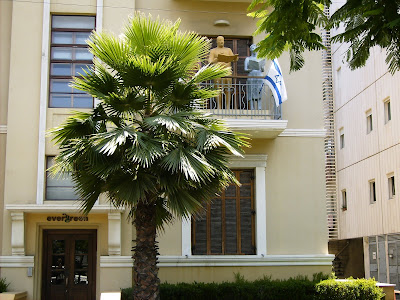
where Prime Minister David Ben Gurion read the Declaration of Independence, May 14,1948 (5 Iyar, 5708). (The declaration was followed by an invasion of the new state by troops from Egypt, Iraq, Lebanon, and Syria, starting the 1948 Arab–Israeli War, known in Israel as the War of Independence.)

The price of freedom is eternal vigilance.
Attributed to Thomas Jefferson, but also to Thomas Paine, Abraham Lincoln, and many others

Everyone here understands intimately the daily struggle to maintain independence — a life, a homeland, and normalcy. (Not by accident does Memorial Day for Israel's fallen soldiers and victims of terror immediately precede Independence Day.)

For now, the national flag — flapping in the spring breezes, flies from cranes, rooftops, cars, windows, and thoroughfares. Today's air shows, family barbecues, and educational broadcast programs follow a night of dancing, singing, and fireworks — welcome pauses in forgetting the existential reality for a few precious hours.

Happy Independence Day!
!יום עצמאות שמח

April 17, 2009

At Tel Aviv's Chinky Beach, Singing the "Song of the Sea"

“Then sang Moses and the Children of Israel” [Exodus 15:1] at the miraculous splitting of the Re[e]d Sea, which we commemorate on the seventh day of Pesach.

This year, in a small Tel Aviv cove facing a sunset view of the Mediterranean Sea, the city's four liberal Jewish congregations met at Chinky Beach and sang the "Song of the Sea."

Watch the video (2:52 minutes).


My related post
In Tel Aviv: The orange on the seder plate

March 31, 2009

Shawarma: A taste of pure Israel

At Manah va-Khetzi [Hebrew: portion-and-a-half], loyal patrons join a fast-moving line to order shawarma, the house specialty, with trimmings of their choice — served with signature local hospitality and blaring radio.

Manah va-Khetzi is sandwiched among small low-cost fast-food shops on Yohanan Ben Zakai Street, on the edge of Jerusalem's southwest Katamonim (neighborhoods built in the 1950s for Jews who made aliya [ascension] to Israel from Arab countries and Iran).

My friends Judith and Jeff drove us straight to the kosher certified eating place after we left the joyous, deeply moving 90th birthday celebration for Rabbi Jack J. Cohen at its conclusion. They were hungry (at 11 PM!) for a taste of pure Israel, for better or for worse — shawarma.

I had no desire for food of any kind at that hour. Yet I quickly developed a hearty appetite to capture the scene, and aimed my camera at the black and red decor, brown and red meat, and mostly silent eaters exchanging token words on selections, condiments, and payment.

A perfect ending to a perfect evening.

Watch the video (2:33 minutes).


March 29, 2009

Happy 90th birthday, Rabbi Jack J. Cohen

Dearest Jack,

I was not yet twelve years old when my beloved father, Dr. Israel S. Chipkin, died. Minutes before his funeral, I stood in your study with my mother and sister, and my father's siblings. Your kind face, gentle manner, and soft voice helped soothe my shock, turmoil, and pain.

And then, you recited the blessing:
"Baruch... dayan ha-emet" [Blessed is the judge of truth]. I had never heard anyone say these words or discuss the blessing. 

Frozen and bewildered, my inner voice demanded, How could this wonderful rabbi, my father's beloved friend and student utter words so stinging, so cruel? Minutes later, the funeral — a word soup of eulogy and "el maleh rachamim" [God full of compassion] prayer for the dead was a bad blur even while "Baruch... dayan ha-emet" stayed stuck in me
. A decade passed before I could begin to understand the blessing, and I have been wrestling with it continuously to this day. 

Thank you, Jack, for your enduring guidance, kindness, friendship, and example. Mazal tov and happy birthday!
 
Who is Rabbi Dr. Jack J. Cohen?
And why did I share with him this earliest memory?
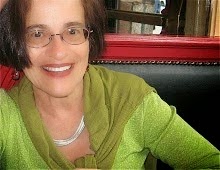
Nearing his 91st year, Jack's family and friends celebrated last week, in Jerusalem, his rich life and long distinguished career as a spiritual leader, educator, author, public servant, and champion of religious pluralism and social justice in Israel and the USA. Jack's children invited guests to share personal memories for inclusion in an album they presented him during the celebration. (The photo at the top of this post captures Jack and me during the celebration.)

Today, Jack is the Emeritus Director of the Hillel Foundation of the Hebrew University. Before making aliya in 1960, he was Rabbi of the Society for the Advancement of Judaism (SAJ), in New York City, where he was a disciple of Rabbi Dr. Mordechai M. Kaplan. (Dr. Kaplan, who founded Reconstructionist Judaism and cofounded the SAJ, opened his eulogy of my father, a pioneering American Jewish educator — "He was dearer to me than a brother.")

NOTE | Writing this post, I found most helpful Rabbi Lawrence A. Hoffman's scholarly and creative discussion on "Baruch... dayan ha-emet"the "el maleh rachamim" prayer for the dead.

UPDATE April 17, 2012 |
.קהילת מבקשי דרך מרכינה ראש ומודיעה בצער רב על פטירתו של הרב דר' יעקב (ג'ק) יוסף כהן, יקיר הקהילה
ההלוויה תתקיים היום, יום שלישי, כה' ניסן תשע"ב, 17/04/12 בשעה 17:30 בבית העלמין "ארץ החיים" ליד בית שמש. הסעה תצא מהקהילה בשעה 16:00 בדיוק. השבעה תתקיים בבית של ירמי וגילה כהן, רח' בר כוכבא 45/10.

יעקב כהן היה רב ומורה מן הדגולים שבדורו ובן אדם שרוח הבריות תמיד היתה נוחה הימנו. לפני כשנה, כשגיל הגבורות היה עשור ויותר מאחוריו, פרסם עוד שני ספרים מקוריים וחדשניים. לזכותו תעמוד גם העובדה שעלה לארץ לפני 50 שנה -- חלוץ אמיתי בין שורות הרבנים המסורתיים בארץ ומחשובי הרבנים הרקונסטרוקציוניסטיים בעולם. יהי זכרו ברוך.

In deep and profound sorrow, Kehillat Mevakshei Derech mourns the passing of our dear friend Rabbi Dr. Jack J. Cohen. The funeral will be held today, April 17, at 5:30 p.m. at Eretz HaHayim Cemetery near Beit Shemesh. A bus will leave from the Kehillah promptly at 4 p.m. The Shiva will take place at the house of Yermi and Gila Cohen at 45/10 Bar Kochba St.
‫ ‬
Jacob Cohen was among the great rabbis and teachers of his generation; he was an easygoing man with whom everyone felt comfortable. About a year ago, when he was already past age 90, he published two more original and innovative books. To his credit, he made Aliya 50 years ago — a true pioneer among Masorti rabbis in Israel and leading Reconstructionist rabbis worldwide.

May his memory be for a blessing.

March 23, 2009

Rabbi Y.M. Lau on Purim in the Nazi camps

During the recent joyous open-air Purim celebration in Tel Aviv, Rabbi Yisrael Meir Lau spoke to the whimsically-costumed multigenerational crowd. At a pause in the Megilla reading, he described an amazing occurrence in a Nazi camp on Purim, and then drew parallels between the ancient Purim story and modern-day challenges.

Watch the video (6:08 minutes).


Note While Rabbi Lau speaks in Hebrew, I added occasional captions in English to guide non-Hebrew speakers.

I dedicate this post and video to dear friends Yehudit Liman (Tel Aviv) and Rabbi Dr. Michael Berger (Atlanta) whose enthusiasm for Rabbi Lau's depth and accessibility inspired my efforts.

My previous Purim posts

March 07, 2009

Reading Amos Oz — אל תגידי לילה, No digas noche

אל תגידי לילה in one hand and No digas noche in the other

My friend Elisheva/Isabel is visiting me in Tel Aviv for a few days. She arrived by train from Haifa, where she's completing a degree in Hebrew Language and Literature at Haifa University. (There, the native French speaker who is also fluent in Spanish has been polishing her Hebrew and learning Arabic and written Aramaic.)

During infrequent pauses in our itinerary, my polyglot friend has been reading Israeli writer, novelist, and journalist Amos Oz's novel Don't Call It Night in the original Hebrew. Rather than check dictionary translations of the occasional word or phrase she doesn't know, she holds the Hebrew volume in one hand, and the Spanish translation in the other.

We have been enjoying marathon conversations (reminiscent of happy hours among Israelis discussing Hebrew literature class), Kabbalat Shabbat services at Beit Tefilah Israeli (a Jewish spiritual community that combines Jewish and Israeli identities), a spontaneous Shabbat dinner (complete with a guest!), and a sing-along of Israeli Golden Oldies led by Nachum Heiman (one of Israel's most beloved composers of popular songs) at the Tel Aviv Cinemateque.

Despite my linguistic limitations (our conversations are restricted to Hebrew and English), we communicate perfectly.

February 17, 2009

Mt. Tabor, Israel — lessons and gifts

Last spring, I spent a day at Mt. Tabor, north of Tel Aviv. Something about this mound of earth at the junction of ancient strategic highways — "the battlefield of the nations" (Mark Twain) captured my imagination. And the months following the visit, I felt a compulsion to learn more...

Now that I'm back in Israel, I'm looking forward to catching up soon with many people you'll "meet" here (5 minutes).


February 05, 2009

An Israeli Arab "Profile in Courage": Marwan Amer

With my "cousin" Marwan in Beersheba, in southern Israel
We met last spring at a celebration of families whose children attend the Hagar Arab-Jewish kindergarten in Beersheba. I traveled from Tel Aviv to meet the students, their parents, and community — an oasis of hope trumping ignorance, cynicism, and despair. My digital story Jewish-Arab Kindergarten relates part of their heroic tale.

Within minutes, Marwan and I discovered that we share a deep affection for my cousin Khanan, principal of Jerusalem's largest primary school. Marwan, an interfaith leader and trained facilitator for the Adam Institute for Democracy and Peace, has worked with Khanan and other educators to break down stereotypes and teach nonviolent methods of conflict resolution in schools.

When Marwan introduced me to his wife, Sarah, she immediately said, "stay with us as long as you like" or to join them most weekends in Kafr Qasem, their hometown in northern Israel. We pledged to meet again.

Seven months later, Operation Cast Lead broke out
Beginning in December 2008 and ending in January 2009, Israel launched a military campaign in the Gaza Strip aimed to stop Hamas rocket attacks on southern Israel and target Hamas members and infrastructure. It achieved little of value for anyone.

During the military campaign, I couldn't imagine life for Marwan and his family — dodging Hamas rockets while many fellow Jewish Israeli citizens are hostile toward Israeli Arab citizens. I was worried sick and called or emailed Israeli family and friends daily. At first, I hesitated calling Marwan, unsure whether a conversation might feel awkward for us or add to his stress.

Staying alive, together
Marwan's young daughter answered the phone. (He later told me that she watched on TV her school hit by a rocket.) When he came to the phone, he gasped. I stammered, weeping, "I am so terribly sad. For everyone. How are you?"

He explained that initially, he and Sarah brought their three young children to their grandparents in Kafr Qasem to escape Hamas rocket attacks in the south. Two weeks later, the children and parents missed each other terribly, so the children returned home to Beersheba. With local schools closed and rockets raining steadily, the family mostly stayed inside.

Peace work does not stop for war
"How are you, Marwan?" I pressed. "What about your peace work while escalating violence threatens the dream?"

And with his reply, Marwan, an unstoppable force for good, captured my Profile in Courage Award.

The Greater Beersheba Arab-Jewish teen group is continuing to meet. While the Jewish families would not allow their kids into Arab villages since the war, all the parents gave permission for the group to travel to Tel Aviv to meet [1.5 hours distance and requiring vehicles, fuel, and logistical arrangements]. There, in the Israel Boy and Girl Scouts Tel Aviv troop building, the teens are discussing the situation and how they feel and think about it. Our peace work has not stopped. And it will continue.

Related Post
Jewish-Arab Kindergarten

January 28, 2009

Blessing for Tamar and Helen

Helen came for lunch today. Earlier, when we had confirmed our visit, she volunteered, "I wrote a blessing. I wrote it for you and me," she hinted.

My friend, the gifted liturgist (she served on Emory University's Candler School of Theology faculty from 1981-1999) arrived bearing a copy of her recent book, "Mother Roots: The Female Ancestors of Jesus" (the opening chapter: "Tamar: A Woman Who Sought Justice"). Helen also brought a copy of the blessing and too many yummy desserts.

When she recited the blessing, Helen spoke the Hebrew word ruakh twice. In this context, ruakh means soul, spirit, essence.

Watch the video (3:57 minutes).

January 23, 2009

From Abby's place: Hail to the Chief!

Abby's evite to the
Inauguration-viewing brunch bunch

The scene: Abby's art-and-book-filled sunny home with to-die-for views.

The crowd:
A merry band of 32 adults, one middle-schooler, and three rescue dogs.

The gifts: One friend brought three vases bursting with yellow and red tulips. Another gave Abby an Obama Action Doll (shown in the photo) that she clutched tightly, posed with, and waved.

The activities:
FOAs (Friends of Abby) mingled, flowed — sometimes seemingly floating, always eating, usually transfixed at the Temples of CNN (headquartered in the living room) or PBS (my religion) in the den.

The mood:
Severally and together, bursts of joy, relief, disbelief, pride, oohs and ahhs, tears, smiles, shouts, laughs, human growls, and doggie speak.

The food: Oh, the food. And, those mimosas.

The call: The day after a national holiday — Happy birthday 2009, Rev. Dr. Martin Luther King, Jr., when America inaugurated its first African American President in an astonishing celebration, we were riveted to President Obama's call [transcript and video here] to embrace the hopes, challenges, opportunities, and responsibilities upon us.


Photo credit: Susan Walsh/Associated Press

January 14, 2009

And the "Smile Project" 2009 winner is . . . me

With Bren Bataclan, holding my prizes
at New York City's South Street Seaport

I wish I could say that I have been steadily Smiling at random, from Atlanta to Jerusalem with the Smile Project. In that post, I blogged on my pledge to do so after I spied, then plucked Bren's bright painting of a colorful, happy, whimsical creature atop a boulder in front of the U.S. Centers for Disease Control and Prevention (CDC) headquarters in Atlanta. Winning the 2009 award (for the best feedback entry) has pricked my conscience, triggering my pledge renewal.

A note taped below the painting read that for the mere pittance of a promise to smile at random people more often, and to send Bren feedback (guidelines here) on where I found it, the painting was . . . mine.

The next month, I brought it to my cousins in Jerusalem, spreading smiles across the ocean.

Feedback from Jerusalem to Boston
Teen cousin, Daniel (shown holding the painting), emailed Bren (through me) the requested feedback (in English, Daniel's second language after Hebrew).

Hi Tamar, How are you? I wrote a feedback [below] to Bren, the man that painted the cute thing... I just don’t know how this sweet creature named. I hope that it’s fine. (There are many words that I’m not sure if they need to be fixed...)

° ° °
"Dear Bren, I was amazed to see your lovely painting. In fact - he coused me to smile. I glad that there are people like you - carring other people like you - carring other people to be happier. — Daniel Zohar, דניאל זוהר"

Then, I invited Daniel to join in a brief Q&A.

Me: Where did you hang the painting?
Daniel: Over the shelf in the living room.

Me: Are you smiling at more people?
Daniel: Yes though I don't know if its because of the picture.

Me: Do others in your family smile at random more often?
Daniel: Same answer... and they express more joy.

Me: How old are you, and in what grade?
Daniel: 15 years old, in 10th grade.

The painting over the shelf in the living room

New friendships, worldwide
While finding the painting in Atlanta has been bringing smiles in Israel, finding it also launched my friendship with Philippine-born, U.S.A.-educated Bren, who began The Smile Boston Project in 2003, his street art project to brighten spirits worldwide.

After months' intense planning and detailed scheduling, last September, Bren (from Boston), I (from Atlanta and Tel Aviv), and Daniel's brother Dear Israeli Soldier, Dear Aviah (from Jerusalem) met in New York City to celebrate The Smile Project and the painting that linked us. (In the photo, an iPod classic with Belkin microphone attachment is capturing Bren's answers to our questions.)

Pay attention
Wherever you go, be alert. The Smile Project might be on your path — a painting and this invitation:

January 05, 2009

Raising high the Israeli flag

Israeli flag facing the highway
north of Tel Aviv, close to Ra-anana

Here is what Karen Alkalay-Gut entered in her Tel Aviv Diary today:

I've dusted off our flag and am getting ready to hang it up on the balcony. It is a strange impulse, born of much debate. The energy we expend debating on ethics is exhausting, but I've finally decided to let the flag speak for us.

The rest of her diary entry follows (I added the links):

A few words with a close friend from the USA last night on the phone got me thinking about it — he assumed the war is unnecessary, and I agree. So here are my criticisms and my conclusions.
  1. I would have been much happier if we had made more direct efforts to speak with Hamas.
  2. Hamas has been sending us antipersonnel rockets for years on civilian targets and trying to kidnap soldiers. Gilad Shalit was in Israel when he was kidnapped. That fact alone is Casus belli [the justification for acts of war]. But we did nothing — except accept their threats, attempts at humiliations, and propaganda.
  3. The world expected nothing from Hamas — no discussions, debates, proposals.
  4. The rockets are still falling on Israel.
  5. The attempt to minimize damage to citizens in Gaza is one of the causes of Israeli soldiers being wounded and killed right now.
  6. While we all seem to agree on the number of casualties in Gaza, Israel and the rest of the world don't quite agree on the percent of civilians lost. Israel says less than 100. Palestinians says most are women and children.
  7. In fact, most of the international news runs counter to what I know from people who are actually activating elements of the war. And as parents and partners and relatives and neighbors we are never ignorant of what's going on.
  8. Though I am constantly aware of the situation of the Arabs in Israel, I really believe they are in much better shape than they would be living in any Arab country, although we have no oil.
So I'm hanging out my flag.

If you're not afraid to, you might want to do it too. Members of my family, by the way, have been getting death threats on Facebook.

January 01, 2009

New Year's Day 2009 | tranquility in your palaces | שלוה בארמנותיך

Peace seeker Mohammad Shibli's dovecote
Shibli, Israel


In her New Year's Eve post on Hard Times, Ronni Bennett, sage and virtual friend (lucky me) wrote: "Hard times. . . We have survived other challenges, some of our own making, and we will do it again this time."

My amen is (deceptively) simple.

יהי שלום בחילך ושלוה בארמנותיך
תהילים קכ"ב
May there be well-being within your ramparts,
tranquility in your palaces.
Psalm 122:6

The scholar Robert Alter, in his notes from The Book of Psalms: A Translation with Commentary, writes on his English-rendering of the Hebrew verse, "As in many lines of biblical poetry, there is a narrative progression from the first verses to the second — first the ramparts, then the palaces within them, following the path of the pilgrim coming up to the city."

December 22, 2008

Who is Tamar? Chief Rabbi Sir Jonathan Sacks comments on your Biblical “date”

Tamar (Hebrew: date palm tree, date fruit) at
Tel Aviv University campus date palm sculpture
Weekly, I eagerly await the Covenant and Conversation commentary on the weekly Torah reading. Sir Jonathan Sacks, Chief Rabbi of Britain, examines (via web, email, and podcast) the Torah as it unfolds along the annual cycle of Torah portion readings. Last Shabbat, Genesis 37:1-40:23 features my namesake, Tamar, among other developments. In this blog post, Torah translations are from Robert Alter's The Five Books of Moses: A Translation with Commentary. 

We know little except her name, Tamar
Judah, fourth of Jacob's twelve sons, had "gone down" — a spiritual and physical decline after proposing to his brothers that they sell into slavery Jacob's showoff favored son, Joseph. Judah is now married to a Canaanite woman who bore him three sons: Er, Onan, and Shelah. When Er grows up, Judah finds him a wife, Tamar.

Tragedy strikes
Er "was evil in the eyes of the Lord" and dies. (The text does not describe the evil.) Judah instructs his second son, Onan, to marry Er's widow, Tamar, in a levirate marriage in which a widow's brother-in-law must marry her if the brother died childless. Onan, who "would waste his seed on the ground" rather than fulfill the obligation, is punished by death.
Judah, fearing that his third son might die, too, if given in marriage to Tamar, sends her to "stay as a widow" with her father until Shelah is old enough to marry her. There, Tamar remains a "living widow" unable to marry while bound to her remaining brother-in-law.

Taking destiny in her hands
When Tamar learns that Judah is approaching nearby Timnah for the sheep shearing, she veils her face, dresses as a prostitute, and stands on the road he will take. Judah approaches and sleeps with her, and she becomes pregnant and returns home. Three months later, her disguise long removed and condition apparent, people inform Judah. Indignant, he reasons that she is guilty of adultery because she is bound to Shelah. "Take her out to be burned," he orders.

A significant detail
In Tamar's ruse, before performing services for Judah, she negotiated payment and insisted on a pledge — his seal, cord, and staff.

When he sends a messenger to pay Tamar and reclaim the pledge, she cannot be found in her masquerade costume. Appearing as herself, she returns the pledge items with the message, "By the man to whom these belong I have conceived." In this masterly stroke, Tamar has established her innocence without shaming Judah who alone understands the course of events. Her discretion inspired the Sages to claim that one willingly be thrown into a fiery furnace rather than shame someone in public.

What was Tamar up to?
According to the Midrash of Nahmanides and of Hizkuni, Tamar was following the levirate marriage custom in which absent the possibility of the deceased husband's brother marrying his widow the father-in-law or a close relative can take his place. Tamar's piety ensured that her husband Er's name and family line would continue.

Ruth's story told in the Book of Ruth is similar to Tamar's. Both begin with a father-in-law's descent. In both stories, marriageable sons die: Judah's sons Er and Onan; Elimelech's Machlon and Chilyon. In both, a widowed woman is childless, and a woman's bold act triggers the denouement. Tamar poses as a prostitute, and Ruth lies at the feet (a euphemism!) of Boaz. In neither case are the men next in line in the levirate marriage (for Tamar, it was Shelah; for Ruth, the anonymous Peloni-Almoni, whose claim Boaz asks to forego).

Why mention Tamar and Judah in the Book of Ruth?
The Book of Ruth states explicitly the connection between the women. When the elders permit Boaz to buy Naomi's field and marry Ruth, they pronounce, "May the Lord make the woman who is coming into your home like Rachel and Leah who together built up the house of Israel . . . May your family be like Perez whom Tamar bore to Judah."


This Book ends with a genealogy that counts ten generations from Peretz to King David whose family tree begins with Peretz, born to Judah and Tamar, and, the seventh generation son Obed, born to Ruth and Boaz. Thus, the family tree of Israel's great and future King includes Tamar and Ruth whose virtue, loyalty, kindness, and discretion contributed to David's greatness.

Heroines at the extreme 
margins of Israelite society
Ruth is a Moabite; we are not told Tamar's family origins. The Sages say she was descended from Shem; Philo ((20 BCE - 50 CE), that she was the child of idolaters. Yet, says Boaz of Ruth, both women bear children "to maintain the name of the dead . . . so that his [deceased husband's] name will not disappear." And both are sensitive to the living — Tamar by not shaming Judah, Ruth by not letting her mother-in-law, Naomi, return home alone.

The stories of both women, childless widows and outsiders move me deeply. Tamar and Ruth, powerless yet of moral courage, wrote their names into Jewish history as role models who gave birth to kings, reminding us that true royalty lies in love and faithfulness, and that greatness often exists where we expect it least.

November 23, 2008

Josh Gomes is scoring points for Israel

We are family. Yup.
Looking at the photo, you might wonder, Huh? Family? What’s up with that?

Watch the video (7.5 minutes). Then, "listen" to more of Josh's unique voice in his email below the link.


On Feb 20, 2008, at 9:37 PM, Josh Gomes wrote: 

I just got home [to Binyamina] from the Jerusalem trip! Wow, it was the best. ... I have things on my phone like the Western Wall (where people put their prayers to Jesus or God in cracks between the stones), Mt. Zion where King David was buried, Mt. of Olives, and the walk that Jesus made to Calvary on the Cross (aka Via Dolorosa). I will show you in time.

But yeah, after that we went to The Holocaust Museum [Yad Vashem, The Holocaust Martyrs' and Heroes' Remembrance Authority]. 6 million Jews and more died, and over 3 million of them were from Poland! We had a 3-hour tour lady, and she was the best. The sights I saw I will never forget. The devil had to be full force in Hitler for him to get an entire country to abide through all this.


The most interesting fact about the gas chambers in Germany is that only 30-40 Nazis ran each camp. And over an entire year, well 13 months, 900,000 Jews died in one camp through just 30-40 men's doing. Also, I didn't know that Americans knew what was going on, not from the beginning, but they knew during the stages of this and did nothing besides a few bombs in not effective areas. All they had to do was bomb Auschwitz and the railroads that took the Jews to the gas chambers. They came when it was all said and done, and acted like they were shocked! I mean, I am sure some were, but still.


I didn't really know how much Poland was hit. The towns they did it in... I saw those towns every road game and not knowing history was there 60-65 years ago. They had the "Ghetto" in Warsaw. How they did those people I will never forget. When the people were dead, they had a bulldozer like they do snow and just piled and pushed the dead people into these caves that they made. Aw, man, that time had to be one of the worst periods ever.


The tour lady made sure we knew everything so we can continue the story for generations to come! I'm glad I took the opportunity.


Related posts

November 05, 2008

בָּעֶרֶב, יָלִין בֶּכִי; וְלַבֹּקֶר רִנָּה | Psalm 30:6

At evening, one beds down weeping, / and in the morning, glad song.

The scholar Robert Alter, in his notes from The Book of Psalms: A Translation with Commentary, writes on his English-rendering of the Hebrew verse, "This upbeat vision of life has, of course, been manifested in the recent experience of the speaker." Further, it precedes a thanksgiving for having been rescued from death.

On November 4, within hours after the epoch-making rescue of America from its death and dying, I heard the speaker-psalmist's Hebrew voice.

The death? Of historic fears, of democracy run aground, of cynicism.

The rescue?
The tectonic-like shift from nearly three hundred years of poisonous racism on the body politic to reason, plans, strategies, and passion for hope and change for all Americans.

. . . the dream of our Founders is alive in our time . . .

. . . lines that stretched around schools and churches in numbers this nation has never seen, . . . [of] people who waited three hours and four hours, many for the first time in their lives, because they believed that this time must be different, that their voices could be that difference.

. . . [wisdom] spoken by young and old, rich and poor, Democrat and Republican, black, white, Hispanic, Asian, Native American, gay, straight, disabled and not disabled Americans who sent a message to the world that we have never been just a collection of individuals or a collection of red states and blue states; we are and always will be the United States of America.

. . . It's been a long time coming, but tonight, because of what we did on this day, in this election, at this defining moment, change has come to America.
— From a transcript of Senator Barack Obama’s victory speech in Chicago, November 5, 2008

My tears of joy, sobs of gratitude are for the greatness which is the human spirit, for our country, and for the trust we have put in Barack Hussein (a name that does not mean a terrorist or an assassin) Obama. Our president-elect, an American just like the rest of us — a mortal, not a deity, not a rock star, as someone viciously described him (really, revealed his own cynicism and envy) in his email among the genuine congratulations Skyped, called, and emailed to me from abroad.

בָּעֶרֶב, יָלִין בֶּכִי; וְלַבֹּקֶר רִנָּה | At evening, one beds down weeping, / and in the morning, glad song.

Voting today in DeKalb County, Georgia

I waited in line only 40 minutes,
thanks to early voting nationwide

(
39 percent of DeKalb County voters
cast their ballots before today).


The wait in line was easy and fun. As with all elections the past ten years, I met many neighbors, fellow synagogue members, and friends — all in my district.

It's a five-minute walk from my front door
to my polling place, Briar Vista Elementary School.


The line waiting to vote snaked along halls
covered with children's work. Here,
the life cycle of . . . pumpkins!


A Venn diagram using Goldilocks and
the Three Bears
and the Three Billy Goats
Gruff
to learn, it appears, size (big, small
medium) and number (3).


Goldilocks and the Three Bears
again,
this time in a lesson on charting
narrative elements (characters, setting,
problem, solution), methinks.


The grand finale: the state of Georgia!
A map showing Native American Cherokee
and Cree tribe areas, and a note: "The men
went hunting and the women harvested."

November 03, 2008

Ramaz School e-reminder: Vote on Election Day, November 4


With Election Day on Tuesday, our current students are eagerly anticipating the result of this historic vote on the national level, and already understand that voting is both a privilege and a responsibility.

We hope that you share their enthusiasm and interest, and we encourage all registered voters in the Ramaz family to vote on Tuesday, November 4.

° ° °

When I was growing up in New York City, my father, of blessed memory, a pioneer American Jewish educator, enrolled me in the Ramaz School family. There, with a double curriculum (religious and secular studies), by eighth grade, I was taking 17 subjects!

Since its beginning, in 1937, Ramaz has been widely recognized for its academic excellence, reflecting the vision of founder Rabbi Joseph Lookstein: ". . . an integrated program of religious studies combined with general studies — a school in which the culture of America would blend with the heritage of Judaism." In this yeshiva day school, "a child would not experience an intellectual or emotional clash between being a Jew and an American."

Between growing up in a traditional Jewish home and attending Ramaz, where I learned Torah, Mishna, Talmud, and cantillation, among other religious subjects, I began to acquire basic tools and confidence to participate as an active member of the Jewish community. Since those early years, followed by continuing studies and experiences, I have been at home anywhere in the Jewish world. Whether I participate in a worship or life cycle service in an orthodox, post-denominational, or secular setting, I am at home. Whether the language is Hebrew or English, I am at home.

My Jewish education and the values that I inherited are liberalizing and universalizing influences in my life. And while my Jewishness plays into my identity, ideas, and activities, no rabbi, political party, lobby group, nation, or Jewish civil law necessarily determines my choices or decisions. I am neither a captive of my greater community nor am I a renegade. The tradition is rich; the tent is wide.

Bottom lines:
  • Daddy, your love and legacy are my strengths.
  • Ramaz School, your continuing education informs my choices.
  • Every American registered voter, if you haven't already done so, cast your ballot tomorrow, and vote!

October 15, 2008

Giving good help: IsraMac and One to One training with Bill Huber

WIth One to One Creative Trainer Bill Huber
at the Atlanta Apple Store in Lenox Mall

As a dual citizen of the USA and Israel who pecks away at her Apple MacBook in both countries, my non-tekky skills (and confidence) get enormous boosts from sage sources on both sides of the pond. Thanks to my dual help systems, IsraMac and to Bill Huber, I can do much more than check email, surf the 'net, and manage myriad aspects of my life electronically.

IsraMac (Israeli Macintosh users discussion list)

This critical first line of defense and troubleshooting is a prized free information source for hundreds of subscribers (not just Israelis or locals!) on most things Macintosh. Almost daily, I get an emailed digest of Q&As on topics ranging from Mac OS tips and tricks to software updates (and crises), items for sale, and requests for service technicians, tutors, and translators. This Yahoo Group's special focus on issues specific to Israeli Macintosh users covers, for instance, Hebrew language compatibility and Mac-friendly (and -hostile) Israel organizations, companies, banks, government offices, and Internet Service Providers (with workarounds, if available).

The IsraMac community of newbies-to-gurus posts questions and answers. For example, guru Tzvi Fabian recently shared a link to Hebrew-English silicone removable keyboard KB Covers! Now solved: my dilemma on "converting" my keyboard from English to Hebrew characters, and back (avoiding cumbersome and inelegant individual Hebrew-letter stickers (they don't stick well) or opening the onscreen Keyboard Viewer (cumbersome)!

To subscribe, send an email to isramac-subscribe@yahoogroups.com.

Atlanta Apple Store superhero

More than five years ago, at Atlanta's Lenox Mall, I brought a sick Mac to Bill Huber who then held the brainiac title, Apple Store Mac Genius — Apple-selected and -trained to know Mac tools, systems, and products. And because not all Geniuses are equal, when the One to One membership program was born, I knew instantly which former Genius would be my One to One Creative Trainer. So when I am in the USA, Bill guides weekly customized training sessions to suit my learning needs. While he remains his signature kind, patient, good humored, respectful, and keenly intelligent self, it is Bill's patience that most boggles my impatient self.

Bill has helped me manage electronic data, streamline backup procedures, and enhance my blogging "chops." I have learned to use Mac applications that I would not have attempted alone, among them Keynote for presentations (such as setting up text and images for my video, Coexistence Kindergarten), iMovie for video production, and GarageBand to manage audio files of interviews I conduct. (Watch Scoring Points for Israel, my interview of Josh Gomes, American shooting guard on Israel's Ramat Gan basketball team.) 

October 08, 2008

Yom Kippur 5769: "Tamar, Why do Jewish people vote Democratic?"

Sharing a meal with hungry people and
engaging with them in loving ways at
Open Door Community, Atlanta, Georgia
Yesterday, coincidentally(?) two days before Yom Kippur, the holiest day in the Jewish calendar, my neighbor Judy and I had a lively two-hour rambling chat on all manner of subjects, save one. Years ago, we had decided to steer clear of politics. Yet in 28 days, we would be voting in the national election for US President and on issues and representatives, hot topics on our minds.

And so Judy confessed, "I cannot resist asking you one question." "Fire away," I encouraged.

"I've long wondered," Judy probed, Why do Jewish people vote Democratic, especially after George W. Bush and the Republican party have been such great friends of Israel?" "Great question, and a fair one," I replied.

Core messages 

Neither presidents nor kings, pundits, bosses, rabbis, nor specific groups decide who earns my vote. For many Jews and others, the Hebrew Bible, especially the books of the prophets inform our core values and visions of a just and decent society, our individual and communal responsibilities to bringing it about, and requirements for leadership. The Democratic party principles, platforms, and policies more than those of the Republican party align with these core messages. On Yom Kippur, we read from the book of the prophet Isaiah verses that encapsulate these messages.

Isaiah 57:14 - 58:14

Later, searching to share with Judy Isaiah's teaching, I stumbled on this creative translation/interpretation by Rabbi Shefa Gold.

... those greedy corporate warmongers!
They are like the troubled sea,
Whose waters stir up filth that pollutes the land,
For them there is no safety, there will be no peace.
... Oh sure, I hear their prayers every day,
They say they want to learn my ways. Hah!
As if you were a people doing righteousness,
Who has not abandoned decency and compassion!
... They say, "Don't you see we're fasting?
Don't you see how holy we have become?"
But on your fast day you wear clothes
that were made by Chinese prisoners,
And shoes that were cried over
by terrified children in loathsome sweatshops,
And the books you hold in your hands,
are filthy with the tears of dying forests...
And your investments fatten the rich,
who are destroying this land.
You think this is the kind of fast I want?
A day that will feed your self-righteousness?
You call this a fast?
... Well, I'll tell you what kind of fast I would desire from you...
Unlock the chains of your greed and habit,
Free you from slavery of being blind consumers,
Let the oppressed worker go free
by raising the minimum wage.
It's a disgrace I tell you!
The fast I want is one that will inspire you
to share your food with the hungry,
To redistribute the wealth of this land fairly,
To build affordable housing for the homeless,
And to welcome back the people you have thrown out of your hearts,
Even the ones in your own family.
... If you banish corruption, hatred and apathy
from the innermost places of your heart,
If you stop blaming everyone else,
And instead extend your hand to the hungry,
And lift up the ones who have been beaten down
by this unjust system,
Then your light will shine forth, even in the darkness.
... From your inspiration people will reestablish
the values that have been desecrated,
And restore the foundations of decency
that have been laid by your ancestors,
And you shall be called 'Repairer of Brokenness,'
'Restorer of the Way'...

May we merit a sweet year, join in repairing our broken world, and elect a just and wise President on November 4.

My related post
5768 (2007) Yom Kippur thoughts: Our choices do matter